The point of this article is to tell you how we, the accessibility team at Hargreaves Lansdown, made our accessibility strategy, and hopefully it's helpful to you, the reader, in helping you to define your own accessibility strategy.
Zoe Coles (Portlock) and I make up the centralised accessibility team, and we have a wonderful group of people around us working side-of-desk, including our AWG (Accessibility Working Group) and our Accessibility Ambassadors network.
This strategy is a culmination of everyone's hard work towards making our services work better for not just disabled people, but for everyone. This is for everyone.
First, some context
At HL you might have heard in the news we're going through some change, we're being bought by some different folk who will take us into being a privately owned company.
It's really exciting to think what awesome things might be ahead. But we all know change can be uncertain and take a long time and new priorities might be either around the corner or down the road.
So as part of our commitment to accessibility we've designed a two-year plan that will give us a solid base whilst we see through this change.
Also, there's a lot of work to do.
Self reflection
Before we got into this, we really had to do some self reflection.
We'd done some accessibility maturity modelling previously to this. I can't speak highly enough for baselining your efforts with a maturity model. There's lots of ones out there:
- AbilityNet have an easy to understand DAMM (Digital Accessibility Maturity Model)
- Business Disability Forum have a great Self Assessment tool
- W3C accessibility maturity model is probably the most open-source, but it's complex
Knowing where you are means you know where you're going
It's tough to look at yourself objectively, but ultimately you have to remember that when things aren't as rosy as you'd like, you have a target to aim for and a reason to prioritise, it might even be a good reason to get your sponsor to give you more budget for people and things.
In our quest for self reflection we started by chatting to our colleagues. At HL we have a really vibrant user centred design team and asking them to see or share something is never an issue.
We spoke with product folk, user researchers, vulnerable client representatives, and ultimately clients themselves. (We call our customers, clients). We're an organisation that really looks after our clients' needs and each other, and that makes doing great work possible. Our values or principles are:
- Client first
- Show Courage
- Always Curious
- Care Deeply
- One Team
And I like that I work for an organisation that publicly supports these empathetic views for people rather than features.
As a centralised accessibility team we have access to our Accessibility Working Group, an Accessibility Ambassadors network and a backlog of absolutely incredible client feedback — when I say incredible, I mean it's constructive and we always hear something we didn't know before. Kudos to our user research team, they mean we're able to dig deep for insight across the organisation.
We ran a survey and retro with our Accessibility Ambassadors to really understand what they need and what differing areas of the business need.
We, as a centralised accessibility team of two, can't be everywhere all of the time and so our Ambassadors are the eyes and ears we don't have, reaching deep into all corners of the business. We will write an article soon about our Ambassadors, they're really awesome and for side-of-desk input, we're really spoilt.
Knowing where you are means you know where you're going and it means you truly understand client (user) impact. After all, clients are the heart of everything we do and the reason we exist. Imagine if our strategy outcomes make more money accessible to more people — that's the hope.
Defining our Accessibility Strategy
There's really two facets to this:
- Firstly having self reflected, as the accessibility experts in your organisation you'll pretty much know your desired outcomes for users and the chances are your intuition will be good.
- But you can't just float away in any direction to do whatever you want. User needs are important and you have to consider the direction set out by your organisation and match your priorities against those too.
It's never exactly pretty, or easy to do, but adding your strategy under the right pillars and values set out by the business means you can more easily assess your ROI (Return On Investment) in a language that the business understands.
Also if you get stuck in the lift with the CEO you want to be able to say how you're working under their leadership and the value you're bringing them. It sounds shallow, but it's a necessity when working in any sector where you're given money to do a thing (so everywhere).
I'm not sure I can share all the HL strategy here, but our target is under a strategic pillar called 'Increase retention' — we strongly believe our clients will value us more if we have an accessible platform. We have quotes from clients saying they value our accessibility efforts and therefore trust us with their money. And it's usually a lot of money so we don't take it lightly.
HL deal with pensions, savings and investments. Our pension clients are with us for the long term, so if we don't have accessible services then we won't retain their business.
Accessibility isn't only for people who are disabled right now, it's for our future selves
Structuring our strategy
So, I suppose this is where you probably skipped to ;)
We split our strategy into four parts:
- A vision statement
- Work categorisation: The Three C's
- Objectives and initiatives
- Desired outcomes
A vision statement: What is it?
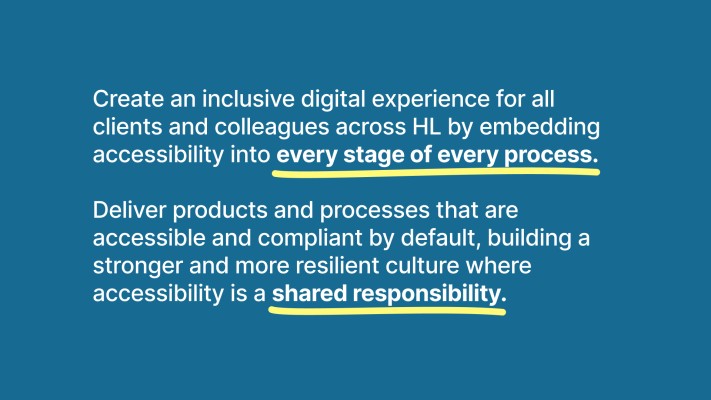
A vision statement is a declaration of your ultimate goal and aspiration. It paints a picture of our organisation's desired future state and provides a guiding star for decision-making and strategic planning via our accessibility team's work.
We think a vision statement should:
- Motivate and inspire stakeholders to work towards a common goal
- Set a high bar and encourage continuous improvement
- Be easy to understand and communicate
- Focus on the desired future state, not the current reality
The Three C's of Accessibility
If you've not seen Craig Abbott's Defining a strategy for accessibility, then you're missing out. We used this as a basis for our own (thanks Craig). As with all things Craig writes, it's a very good read. He sets out his 3 pillars as:
- Compliance
- Culture
- Education
But we like alliterations, and so we changed Education to Capability.
This probably sounds like a shallow decision, but in all honesty we felt that Capability had wider meaning and was more reflective in performance of more things than just people learning things. For example, measuring the Capability of a team. Kudos to Tom Carrington for this suggestion.
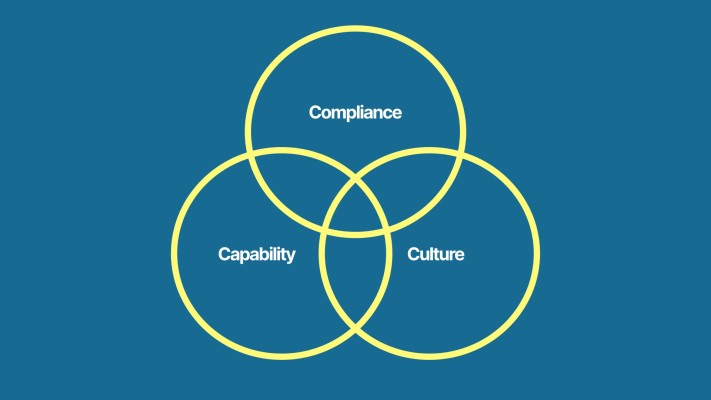
Compliance focuses on ensuring that all products, services, and environments meet relevant accessibility standards and regulations such as WCAG 2.2, the Equality Act and Consumer Duty. It involves conducting audits, wide scale testing, and remediation to address accessibility barriers that people face.
Capability emphasises raising awareness and building knowledge about accessibility throughout the organisation. It includes role specific training, providing resources, and promoting inclusive design principles for client work.
Culture aims to create organisational culture that embraces accessibility in our day to day. Events with guest speakers, mentoring, disability language and etiquette. These all help to create a mindset where responsibility for accessibility is shared and it is considered an integral part of our processes. We already captured hearts and minds this year, with a guest talk from Gareth Ford Williams for GAAD (Global Accessibility Awareness Day) Foundation.
One for all and all for one
All three C's are important individually yet rely on each other to deliver a sustained and resilient strategy over time that puts the needs of our clients and colleagues first.
Each one has an important role to play, I'll explain what happens when we remove one of the C's. Spoiler alert: It's not good.
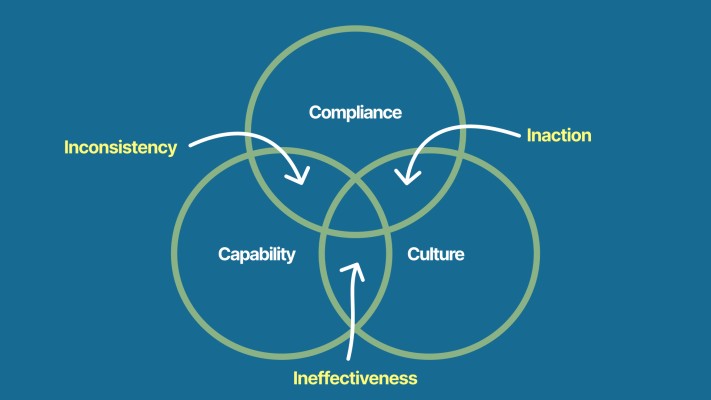
Without compliance we become ineffective. Good intentions and awareness alone aren't enough. Without adhering to WCAG standards and legal requirements, we won't truly address accessibility barriers, and we may even create new ones.
Without capability we become inconsistent. Without capability and training, people's efforts will be based on their own assumptions or biases rather than genuine knowledge. This creates inconsistencies in the way issues are found, changed or improved.
Without culture we get inaction. A lack of buy-in to a culture of accessibility leads to resistance, minimal effort, and a "tick-box" mentality. We want colleagues to feel inspired and left wanting to do the right thing.
Objectives and Initiatives
I won't be able to show these publicly, because they are initiatives born out of our own research, and frankly, they'll be irrelevant to you and your users anyway.
But it's stuff like:
- Improving automated test reporting and tooling (Compliance)
- Building skill progression frameworks and role specific training (Capability)
- Inspiring colleagues to do good, not telling them to do good (Culture)
Within these objectives and their initiatives we've detailed measurements, because without ways to measure how will we know how we did? Some are meticulous numbers and some are very simple, for example: Number of colleagues trained in [X, Y and Z] went up by...
For KPI's (Key Performance Indicators) and ways to measure your progress I highly recommend you speak to your product folk, we have some great product people who are keen Accessibility Ambassadors, shout outs to Luke Albest and Claire Barry for this help.
Expected outcomes
We thought long and hard about the outcomes we expected from our work over the next two years. Not only does this need to link to client needs but also business needs and we think we've hypothesised some pretty good outcomes that are a mix of both.
We work remotely, so we can't stick them up as posters around the office, you can call me a hippy, but these are flash cards I actually have on my desk. They're key reminders to keep going for those days when burnout is looming.
We will see improved ownership and responsibility. Accessibility will become integral, not an afterthought or a burden. We will have a proactive and sustainable approach to accessible products and services.
We will enhance internal expertise. Teams will actively build and share accessibility expertise, creating a ripple effect that enhances HL's approach overall to accessibility.
We will boost morale. People will feel valued, motivated by inclusive design, and that they're making a positive impact (and reducing ambassador imposter syndrome).
We will build trust. We will build trust with clients and colleagues by showing that we are actively tracking and improving our performance relative to competitors.
We will mitigate risk. Through engaging with clients, we will swiftly identify legal and reputational risks.
We will attract and retain talent. Through a public commitment to accessibility, we will attract and retain talent who value inclusivity and social responsibility.
We will stay current. Through relationships with our industry peers, we will keep up with evolving accessibility standards and technologies, so HL remains competitive.
We will create better outcomes for clients. All clients, especially disabled clients will feel confident, valued and fully ready to engage with our products and services.
What's next?
We're building a roadmap, with our Objectives and Initiatives at the core.
We'll set milestones and set up engagement with the right people at the right times. We have an internal monthly newsletter that we'll use to help drive engagement with colleagues about our progress. We believe that transparency is the key to successful outcomes.
We'll also be setting up our KPI's and not be those people that look back at the end of the year to panic and fill out all at once. It's better to fill out as you go, and communicate it.
If you're still here, (this is a long read, eh) we can add some past-tenses to our Three C's to show where we intend to be at:
Compliant. Be far closer to all our products and services will meet, and ideally exceed the expectations set out by accessibility standards and regulations such as WCAG, Consumer Duty and Equality Act.
Capable. Everyone will be able to easily access insights, internal training and resources giving them the confidence to create accessible digital experience by default.
Cultured. From the CEO to interns, more people will understand and want to champion accessibility not as a feature, but as a mindset. People will feel inspired to act.
Are you thinking of making your own strategy?
To try and summarise my points, it's probably best that I frame it in a way that helps you get started on making your own strategy:
- Remind yourself (and your audience: organisation, stakeholders) why accessibility is important
- Frame where you are in your accessibility journey. Be honest about it, even if you're an established team. Just because there's loads to do just means there's loads to do, not that you're not doing well enough. And there is always loads to do.
- Tell your organisation how your strategy will benefit them. Tell them about the people it serves and the impact for users. Work out the ROI (return on investment) and the business case for accessibility. User needs are ultimately key, but users spend money (and businesses like money!).
- Look at strategies out there that already exist. Ask around, DuckDuckGo it — there's a lot of resources out there. Remember we started with Craig Abbott's take on it.
- Speak to your users and colleagues, speak to disabled people. Find out what you know you don't know. Don't ever use a robot, regardless of what these AI companies are telling/selling you.
- Hypothesise your outcomes, and then fill in the gaps of how you'll get there. Get the post it notes out and stick them on a wall (like every UX designer's website ever, lol). Jake Knapp's Day 1 Sprint planning is a good illustration of this.
- Have fun with it. We had so much fun with this work, we went on a real self-discovery journey and the benefits of that are untold.
Good luck, and if you fancy a chat I'm on ADPList. I'm always happy to have a virtual coffee.
This was first published as an article on LinkedIn.
Return to the blog